
Some people might think that if a company trade in the Stock Exchange they should have a tremendous social media rating. Well, it is not necessarily a true statement.
For any organization to earn a successful social media presence, it takes effective planning with tedious hours of evaluation, development of content that will convert audiences’ opinion into loyal followers and supporters of the brand.
Domino’s the perfect example of a company that trades on the stock exchange and started with a humble beginning in the use of social media. The company began in 1960 and continued its growth on to the dot.com era and onward. It was in the latter years of this period Domino’s Pizza started its online order and thirty minutes delivery marketing campaign. The campaign evolved in their enlistment on social media platforms that would benefit.

Two years before Domino’s started business Pizza Hut was established. Over the years, Domino’s became their number one competitor; as both companies raced across our nation and around the globe for market dominance. Pizza Hut held its ground and stood up as the leader during the dot.com era, while embarked on online orders, and later social media marketing, as well.
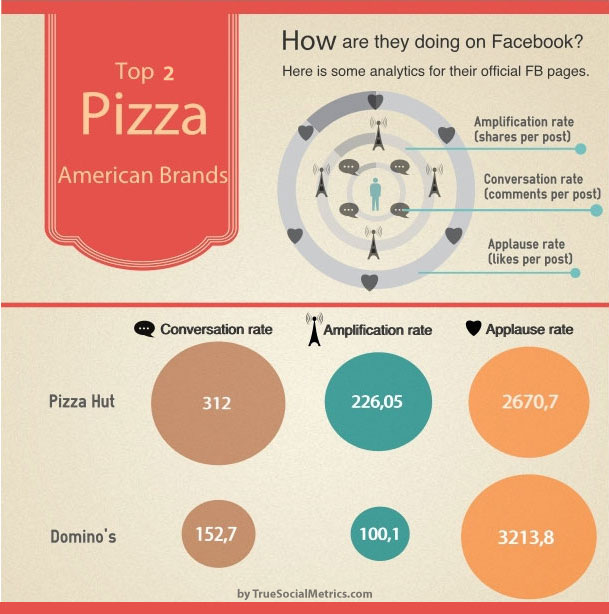
Almost a decade went by as both firms tested and tried different methods in social media marketing. In 2009, Pizza Hut captured eighteen percent of the entire market, while Domino’s had 10 percent, and other percentages had divided among different brands and private local labels. It was evident, Pizza Hut strategy keep the company sprouting out in all direction of social media market – Facebook, Twitter, Vine, Instagram, and YouTube. Likewise, Domino’s had enlisted the services of these social media platforms and have shown a higher number of the total leading in Applause rate, 3213,8 in comparison to Pizza Hut, 2670,7.
The unprecedented turn in evident left critics stunned. Earlier during the same year, 2009 Domino’s had significant adverse publicity. The result of two of its employees posting a disgruntled stun video in YouTube. The event made the company more aware of the do’s and don’ts in the engagement of social media audiences, and how to use strategy messaging to diffuse tension. By the end of the years, the company’s imagery began to change.
What was so essential in the company’s strategy that caused their likeness to spike over Pizza Hut in 2009?
Perhaps, Domino’s immediate reaction to the crisis – the firing of two members of staff involved in the incident, the president of the company made a public speech, and the company set up a strategy body to answer questions about the event?
Undauntedly, Domino’s honest and transparent condemnation of the incident, and their humane diffusion of the crisis prove they care about the public and their perception.
At the same time, Pizza Hut had continued its engagement with its audiences, but their commitment was not strong enough to foster more likes as Domino’s did at the end of 2009 assessment. Even though, some social media analyst warned that a higher number of likes compared to comments show that the organization has the least engagement activity among fans. So, Domino’s should have considered using posts that engaged more of its audiences.
| Conversation Ratio | Amplification Ratio | Applause Ratio | |
| Pizza Hut | 1 | 0.7 | 11.8 |
| Domino’s | 1 | 0.7 | 32.1 |
Almost a decade late, Domino’s still lead the way in social media presence over Pizza Hut. Domino’s generated sixty percent of its sale via digital medium while Pizza Hut fifty-five (Forbes, 2018). Although Domino’s maintain a remarkable upbeat social media campaign in the industry, Pizza Hut had $12.03bn in sales, 2017; Domino’s posted $12.2bn for the same period. The disproportion in Conversion and Amplification Rates between Domino’s and Pizza Hut at the time suggested that Domino’s had more emotional content that created more loyal followers. An indicator that the company did well in the aversion of crisis.
What could have contributed to the difference in earning?
In the same way, Duulin Buks, understand how a company plans and develop social media strategies, essentially will reflect the company’s social media engagement and communities’ association.
Reference
Nikitenko Tania. (2011). TrueSocialMetrics. Top 5 American Pizza’s Brands in Social Media. Retrieved from https://www.truesocialmetrics.com/blog/top-5-american-pizza-brands?locale=en_US
Kelso Alicia. (July 5, 2018). Forbes. Pizza Hut Playing Catch-Up with Digital, Marketing Investments. Retrieved from https://www.forbes.com/sites/aliciakelso/2018/07/05/pizza-hut-playing-catch-up-with-digital-marketing-investments/#3f3e463a2bf2
Blanchard Olivier. (2011). Social Media ROI: Managing and Measuring Social Media Efforts in Your Organization. Retrieved from https://mbsdirect.vitalsource.com/#/books/9780132678025/cfi/6/28!/4/26/4@0:15.4

 duulinbuksjamiekan.blog